
“I Still Have One Hand to Bake”
In a Takeo village, a mother who never went to school turned a one-time $100 gift — and a recipe from her grandmother — into a business that keeps her son in school.
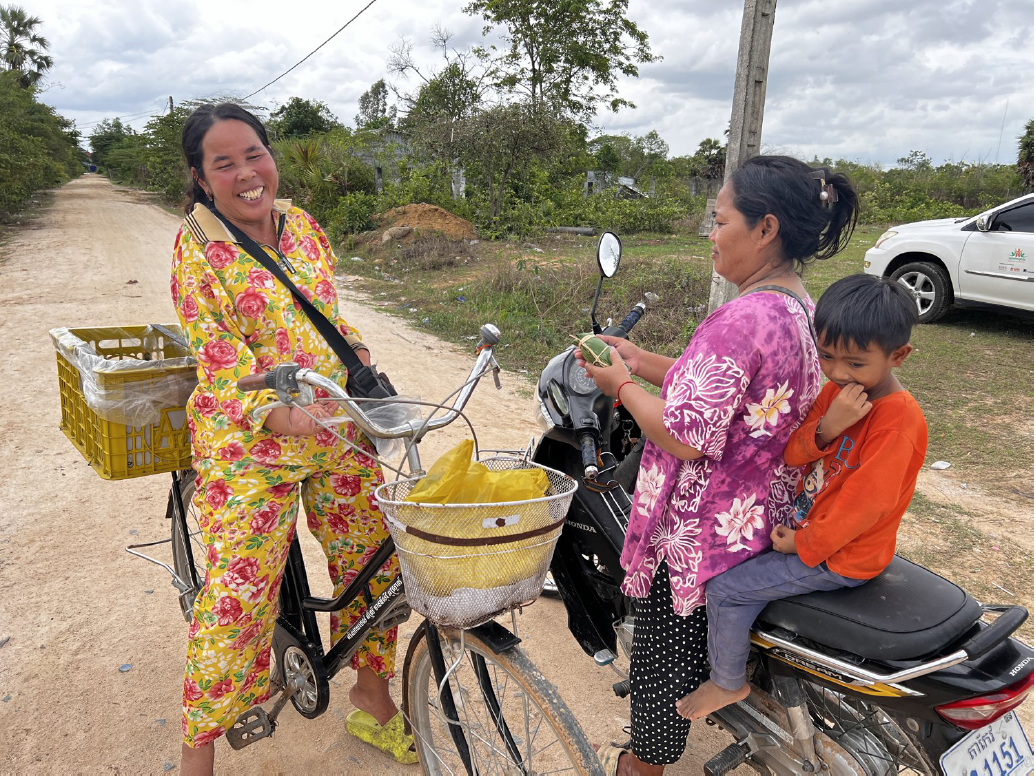
Nget Kunthea sells her cakes along the village road in Takeo province. She delivers by bicycle. Photo: KPY
Nget Kunthea sells her cakes along the village road in Takeo province. She delivers by bicycle. Photo: KPY
Nget Kunthea rolls up to the customer on her bicycle, baskets of cakes strapped front and back, and she is laughing before she even stops. A woman on a motorbike turns one of the banana-leaf packets over in her hand. Money changes hands. This is the business, on a dirt road in Takeo province, in southern Cambodia — and it is the reason Kunthea’s son still goes to school.
“I may have a disability, but I still have one hand to bake delicious cakes.”
Kunthea is forty, and one of her hands does not work like the other — short, with limited movement. Her husband, Vorn Pheakdey, forty-six, has a visual impairment and can see very little. He still takes manual work when he can get it, but he says some employers have not paid him fairly: one recent week’s work, worth about ten dollars, has gone unpaid for more than three weeks. Both parents live with a disability. Together they raise a thirteen year-old son, and for years their income could not stretch far enough — the boy’s schooling was the first thing at risk.
Kunthea never went to school herself. As a child, the stigma around her disability kept her out, and she never learned to read or write. But she was always quick with numbers in her head, and she means for her son to have what she did not. He is quiet and gentle, with two close friends at school. He plays volleyball and likes his Khmer literature class, though he cannot yet say what he wants to become. His mother cannot read the books he carries home — and that is why she wants him there.
What she did have was a recipe. She learned to bake by watching her grandmother — the proportions, the timing, the small secrets that make a cake worth buying twice. It needed only a reason, and a little capital, to become a living.
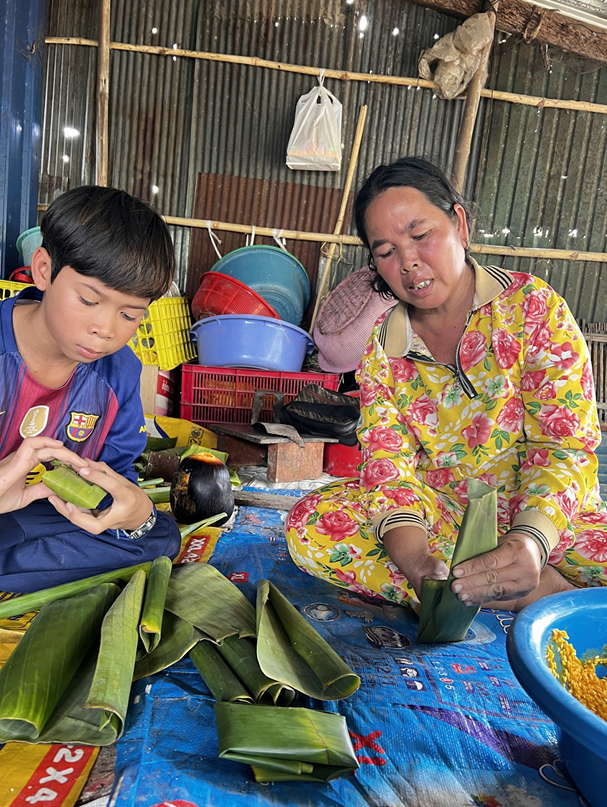
Kunthea and her son wrap cakes in banana leaves at home. The family makes them by hand to sell each day. Photo: KPY
About three years ago, a Cambodian organization called Koampia Phum Yoeung — KPY, which means “Caring for Our Village” — began working with the family. KPY did not hand over money and leave. Its staff sat with them, asked questions, and wrote a plan. Last year, KPY gave them a one-time gift, not a loan: one hundred dollars and the basic equipment to start, down to the big black pot she cooks her cakes in. The local commune’s committee for women and children added support of its own. The rule was firm: the family had to contribute too.
The hundred dollars bought the first ingredients; the pot let her cook them. But the part that lasts is not the money. KPY taught Kunthea to manage what she earns — to tell what the family needs from what it merely wants, and to save a little before she spends. She cannot write the figures down, so she runs it all from memory. She sells her cakes for about 500 riel each, a little over ten cents, and lets a buyer take ten for around a dollar. She bakes a batch to sell each day, and more when an order comes. After the day’s costs, she sets aside about 3,000 riel — roughly seventy-five cents ($0.75) — and the next day she does it again. Some is for an emergency. The rest is for her son to stay in school.
Sim Vibol, the KPY program officer who has worked with the family for three years, has watched it happen. “She values the work more than before,” he says. “Now she sells wholesale as well as one by one, and each day she puts a little aside — some for an emergency, and some so her son can keep studying.”
The income is steadier now, and so is the family’s standing. Because his parents are poor and both live with a disability, the boy was sometimes looked down on by other children. That has eased. Kunthea knows his teachers now and follows his lessons.
KPY’s goal is plain: children from vulnerable families should keep studying, and be seen as equal.
KPY’s wider work helps children in rural communities stay in school, learn practical life skills, and build the confidence to shape their own futures. Through teachers, youth groups, families, and local authorities, KPY connects financial literacy, child protection, and education support so children are not forced out of school by poverty. Kunthea’s family shows why that work matters: when a household becomes more stable, a child has a stronger chance to keep learning.
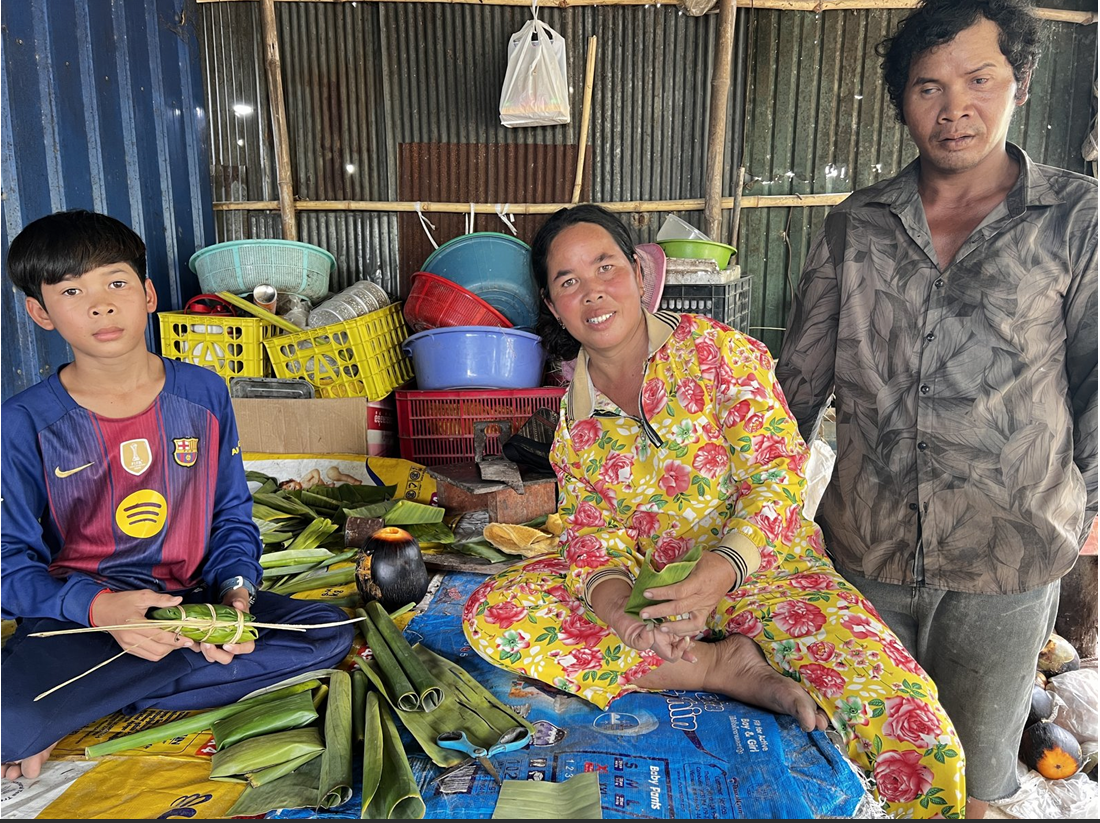
Kunthea with her husband, Vorn Pheakdey, who has a visual impairment, and their son. Photo: KPY
None of it was magic — an assessment, a small grant, repeated training, and staff who kept coming back. KPY works across four Cambodian provinces and was founded with support from Phillip Bank in 2019. Its offices sit inside Phillip Bank branches in those provinces, including Takeo.
KPY’s work responds to a wider financial-literacy gap in Cambodia. According to 2017 research cited by KPY from ADB and the National Bank of Cambodia, only 18 percent of Cambodians have basic financial literacy. Through its financial-literacy modules, KPY reports that 944 local trainers and teachers have been trained, more than 10,800 adults have applied basic financial-literacy principles, and more than 16,200 children have practiced saving and planning for the future.
“When a family succeeds with our support, they keep working and use what they learned,” says Sokkhy Chan, KPY’s executive director. “They improve their product. They manage their money and save a little. And they keep their children in school — all the way through.” In every village where KPY works, staff see more families who could benefit from this kind of support. Current funding limits how many they can reach.
Kunthea knows the work is far from over.
“Life is hard, and it always will be, when you have only one hand — for baking, and for everything else.”
Her eyes fill as she says it, but she holds the tears back. Then she says the future looks brighter than it did.
The impact of a small investment can be extraordinary. A one-time gift of one hundred dollars and basic equipment — with financial-literacy training, mentoring, and follow-up support — helped Kunthea turn a family recipe into a business that feeds her household and keeps her son in school.
Across the communities where KPY works, many families face the same challenges — disability, poverty, unstable income, and few opportunities. Its work rests on a simple idea: find families with potential, give practical help, and stay long enough for change to take root.
Tomorrow, Kunthea will wake before sunrise and begin wrapping cakes again. She still has only one working hand. But she now has something she did not have before: a business, a plan, and a son who is still in school.
Your gift helps KPY reach more families like Kunthea’s with training, mentoring, and practical support. Donate through GlobalGiving.